

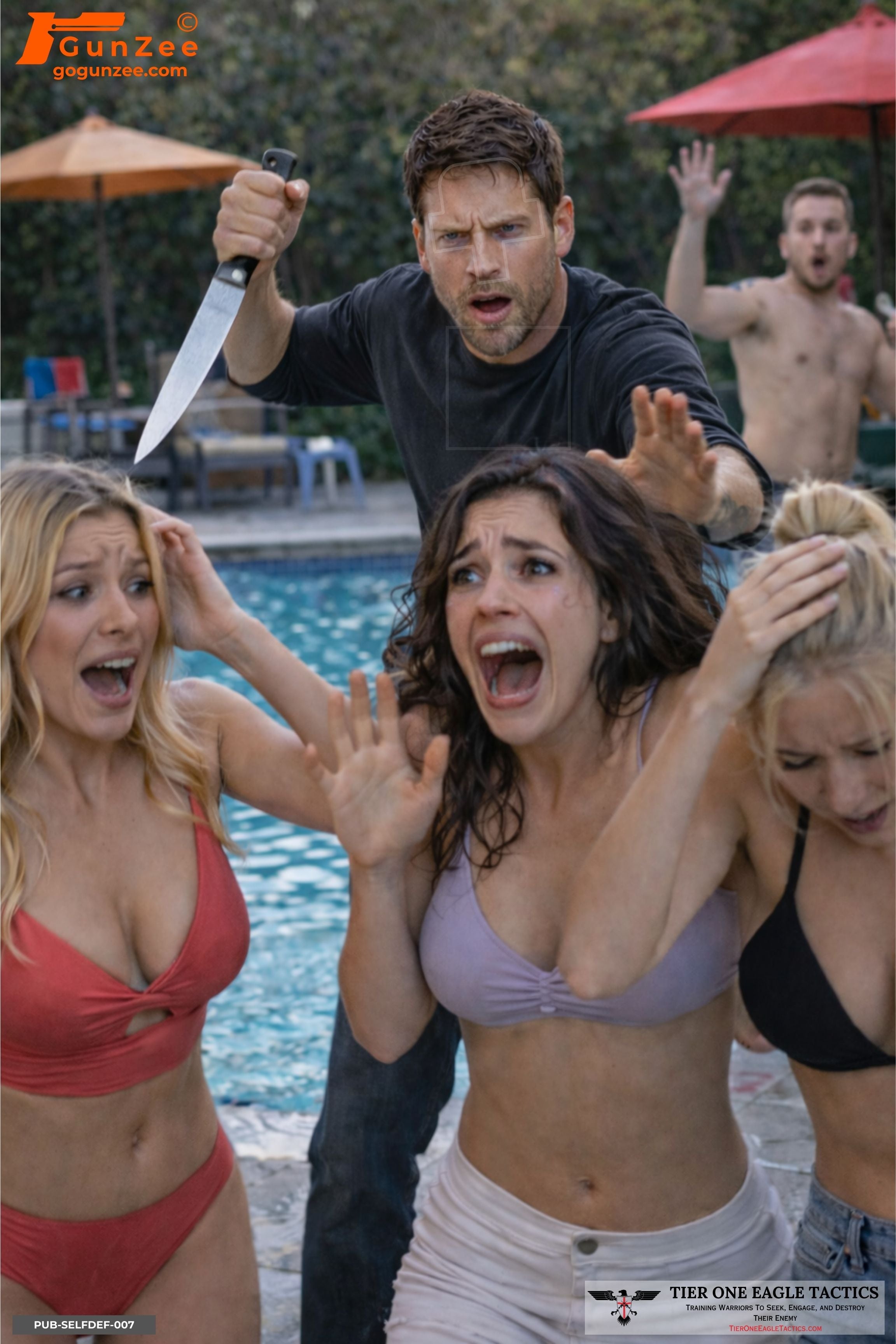
Backyard Pool Knife Assault – Crowd Chaos Scenario [24" x 36"]
Quantity must be in increments of 5
Backyard Pool Knife Assault – Crowd Chaos Scenario
The Backyard Pool Knife Assault training target places the shooter into a rapidly escalating public violence scenario defined by panic, movement, and an imminent edged-weapon threat. Set in a crowded backyard pool environment, this target forces immediate visual processing as terrified bystanders surge, recoil, and partially obstruct the shooter’s view while an attacker advances with a knife.
This scenario is intentionally chaotic. Screaming civilians, overlapping bodies, and constantly shifting angles demand calm threat confirmation and disciplined shot accountability. There is no clean lane, no pause, and no margin for careless decision-making.
This target includes intentionally placed transparent cranial and cardiac kill zones to support post-engagement shot placement evaluation following a training sequence.
Training Purpose
Edged-weapon assaults in public environments are among the most dangerous self-defense encounters due to speed, proximity, and sensory overload. Unlike controlled range drills, real-world incidents involve uncontrolled movement, emotional noise, and rapidly collapsing reaction time.
This target replicates those conditions. The shooter must confirm lethal intent, visually identify the edged weapon, assess distance and closing speed, and determine if and when force is justified while innocent people occupy the immediate foreground. The kill zones are not intended to dictate engagement decisions, but to provide objective feedback after the drill regarding shot placement, precision, and accountability.
Skills Reinforced
- Rapid edged-weapon identification
- Threat confirmation amid visual and emotional chaos
- Shooting with bystanders in close proximity
- Angle management and strict shot accountability
- Cognitive control under stress and distraction
- Close-range lethal threat prioritization
Why This Target Is Different
Most shooting targets simplify engagement by isolating the threat. This... ...
Backyard Pool Knife Assault – Crowd Chaos Scenario
The Backyard Pool Knife Assault training target places the shooter into a rapidly escalating public violence scenario defined by panic, movement, and an imminent edged-weapon threat. Set in a crowded backyard pool environment, this target forces immediate visual processing as terrified bystanders surge, recoil, and partially obstruct the shooter’s view while an attacker advances with a knife.
This scenario is intentionally chaotic. Screaming civilians, overlapping bodies, and constantly shifting angles demand calm threat confirmation and disciplined shot accountability. There is no clean lane, no pause, and no margin for careless decision-making.
This target includes intentionally placed transparent cranial and cardiac kill zones to support post-engagement shot placement evaluation following a training sequence.
Training Purpose
Edged-weapon assaults in public environments are among the most dangerous self-defense encounters due to speed, proximity, and sensory overload. Unlike controlled range drills, real-world incidents involve uncontrolled movement, emotional noise, and rapidly collapsing reaction time.
This target replicates those conditions. The shooter must confirm lethal intent, visually identify the edged weapon, assess distance and closing speed, and determine if and when force is justified while innocent people occupy the immediate foreground. The kill zones are not intended to dictate engagement decisions, but to provide objective feedback after the drill regarding shot placement, precision, and accountability.
Skills Reinforced
- Rapid edged-weapon identification
- Threat confirmation amid visual and emotional chaos
- Shooting with bystanders in close proximity
- Angle management and strict shot accountability
- Cognitive control under stress and distraction
- Close-range lethal threat prioritization
Why This Target Is Different
Most shooting targets simplify engagement by isolating the threat. This target deliberately removes that comfort.
Multiple panicked civilians create visual clutter and unpredictable movement that challenge the shooter to:
- Read body language and weapon intent instantly
- Resist tunnel vision under stress
- Control muzzle discipline and engagement angles
- Process depth, spacing, and motion simultaneously
This target rewards disciplined judgment and punishes rushed decisions. It reflects the uncomfortable reality of public violence—loud, chaotic, and unforgiving.
Scenario Context (Educational)
Knife attacks often unfold at extremely close distances and escalate without warning. Attackers can close gaps faster than many shooters anticipate, especially when victims are distracted, trapped, or surrounded by others.
This scenario emphasizes recognizing imminent lethal intent, understanding reactionary gaps, and maintaining accountability when innocents are directly in harm’s way. It reinforces that correct decision-making is as critical as marksmanship.
Kill Zone Reference System
This target includes transparent cranial and cardiac kill zones used exclusively for post-engagement shot placement evaluation.
Cranial kill zone (modified T-Box)
The cranial kill zone is based on the conventional T-Box, defined by a horizontal reference across the upper lip or base of the nose and a vertical reference between the eyes. This target uses a modified T-Box that expands upward into the lower forehead region, reflecting anatomical areas known to cause immediate neurological incapacitation when disrupted. The expanded region accounts for head movement and real-world presentation angles and is intended strictly for evaluation after the training sequence.
Cardiac kill box (upper thoracic cavity)
The cardiac kill box represents the upper thoracic cavity, encompassing the heart, aortic arch, and major vascular structures associated with rapid physiological incapacitation. Hits within this zone are evaluated for placement, timing, and precision rather than guaranteed outcome.
These kill zones are training references only. They are not scoring rings, not mandatory aim points, and not a substitute for lawful judgment or threat assessment.
Related training targets
Pair this target with related scenarios from across the GunZee catalog:
Public and everyday self-defense: Advancing Crowd Knife Assault Shooting Target, Public Knife Assault Disarm – Close-Range Edged Weapon Encounter, Crowded Street Knife Threat Shooting Target, Dual-Threat Mall Corridor Assault Shooting Target
Home defense, CQB, and hostage: Zombie Dog Charging Novelty Home Defense Shooting Target, CQB Home Defense Hostage – Forward Weapon Presentation Shooting Target, Interior Male Wearing Body Armor Unarmed Threat Assessment Shooting Target
Vehicle and barrier: Vehicle Barrier Dual Gunmen Front-and-Rear Seat Engagement Shooting Target, Vehicle Barrier Elderly Victim Carjacking Shooting Target, Vehicle Barrier Daylight Carjacking Shooting Target
Anatomical: Anatomical Frontal Handgun Threat Vital Zone Shooting Target, Anatomical Full-System Vital Zone Shooting Target, Anatomical Side-Profile Rifle Threat Shooting Target