Read the Privacy Policy
Quantity must be in increments of 5
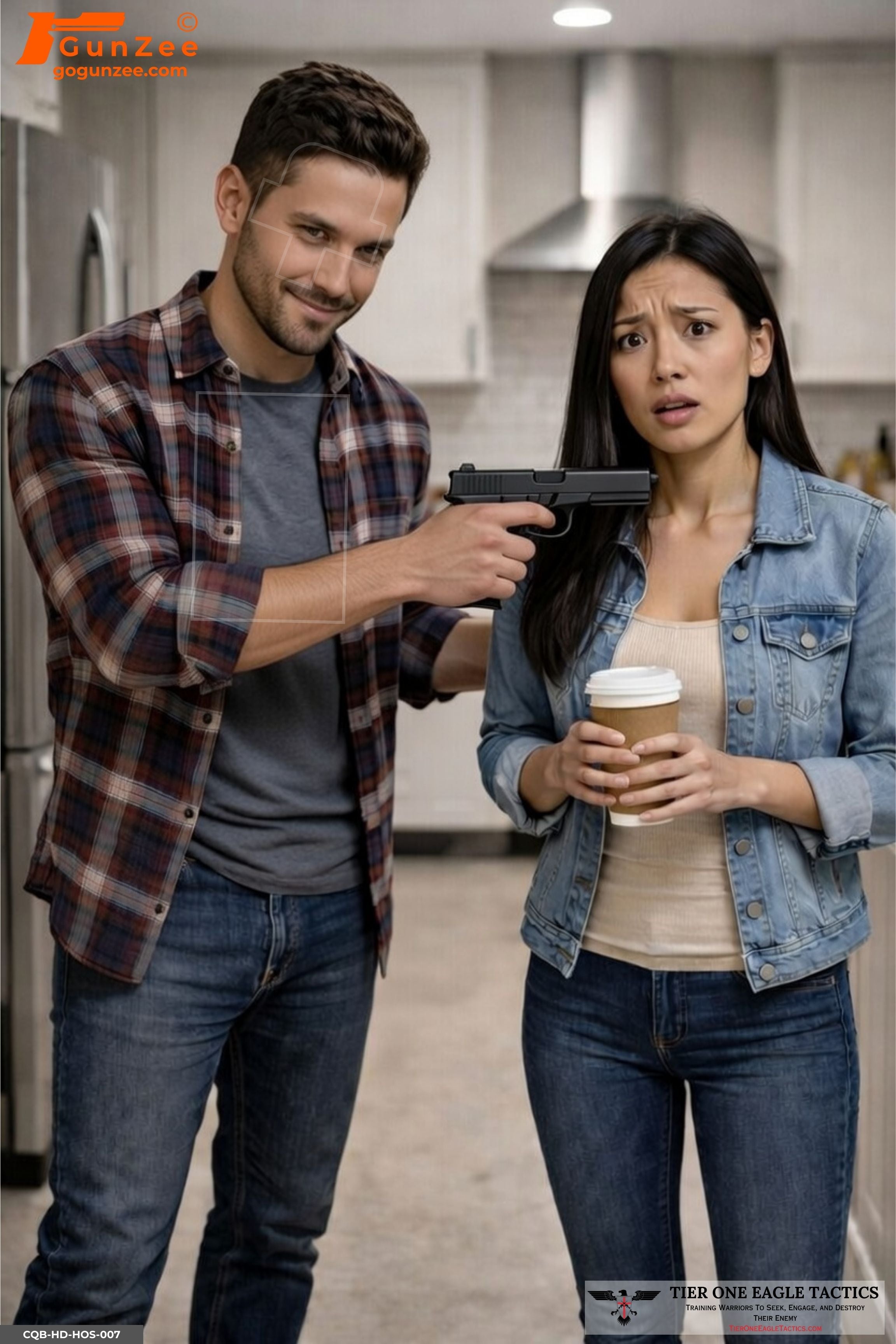
This CQB Home Defense Hostage Shooting Target depicts a close-quarters confrontation inside a residential kitchen where an armed aggressor presents a handgun toward an innocent individual at intimate distance. The environment is familiar and domestic, the spacing is compressed, and the interaction appears personal rather than overtly criminal.
What makes this scenario especially dangerous is not just the firearm, but the conflicting emotional signals. The aggressor’s facial expression suggests confidence and control rather than panic, while the victim’s expression reflects confusion, fear, and uncertainty rather than immediate resistance. These subtle cues can dramatically influence perception and decision-making under stress.
Real-world defensive encounters frequently occur in familiar spaces and involve people who do not fit a stereotypical threat profile. This target is designed to train shooters to evaluate threat behavior, intent, and emotional indicators rather than relying solely on weapon presence.
The facial expressions in this scenario play a central role in the training value. The aggressor’s relaxed or deceptive demeanor may delay recognition of lethal intent, while the victim’s visible distress confirms coercion without overt physical restraint. Shooters must reconcile these cues quickly and accurately to determine whether and how force may be justified.
Many training targets depict exaggerated fear or obvious aggression. This target intentionally avoids those extremes. The aggressor’s expression suggests calm dominance... ...
This CQB Home Defense Hostage Shooting Target depicts a close-quarters confrontation inside a residential kitchen where an armed aggressor presents a handgun toward an innocent individual at intimate distance. The environment is familiar and domestic, the spacing is compressed, and the interaction appears personal rather than overtly criminal.
What makes this scenario especially dangerous is not just the firearm, but the conflicting emotional signals. The aggressor’s facial expression suggests confidence and control rather than panic, while the victim’s expression reflects confusion, fear, and uncertainty rather than immediate resistance. These subtle cues can dramatically influence perception and decision-making under stress.
Real-world defensive encounters frequently occur in familiar spaces and involve people who do not fit a stereotypical threat profile. This target is designed to train shooters to evaluate threat behavior, intent, and emotional indicators rather than relying solely on weapon presence.
The facial expressions in this scenario play a central role in the training value. The aggressor’s relaxed or deceptive demeanor may delay recognition of lethal intent, while the victim’s visible distress confirms coercion without overt physical restraint. Shooters must reconcile these cues quickly and accurately to determine whether and how force may be justified.
Many training targets depict exaggerated fear or obvious aggression. This target intentionally avoids those extremes. The aggressor’s expression suggests calm dominance rather than chaos, while the victim’s expression conveys fear without physical struggle.
This contrast mirrors real incidents where attackers rely on psychological control rather than visible violence. The target rewards shooters who process context, body language, and emotional signals instead of reacting only to the presence of a firearm.
This target includes a modified T-box outline that expands beyond the traditional eye-to-eye reference by incorporating a defined area in the upper forehead. This modification reflects established understanding that disruption in this region is associated with immediate incapacitation due to proximity to critical central nervous system structures.
The modified T-box is not intended to be visible or used as an aiming reference at shooting distance. It exists strictly for post-exercise analysis and instructor-led review. After the drill, the outline allows shooters to evaluate whether a precision option truly existed given the proximity of the victim and the aggressor’s head position.
This target also includes a cardiac box outline to support post-exercise evaluation of center-mass decision-making. In close-contact domestic scenarios, center-mass engagement may be partially obstructed, legally complex, or tactically unsound due to the victim’s position.
The cardiac box is not intended for live aiming use. Instead, it allows shooters and instructors to review shot placement after the exercise and discuss whether center-mass engagement would have been viable or whether restraint or alternative responses were more appropriate.
Pair this target with related scenarios from across the GunZee catalog:
Public and everyday self-defense: Convenience Store Counter Robbery – Close-Range Threat Recognition Shooting Target, Bank Lobby Active Robbery – Multiple Armed Suspects with Body Armor Shooting Target, Plainclothes Officer Badge Reveal – Law Enforcement Identification Scenario
Home defense, CQB, and hostage: CQB Home Defense Hostage – Forward Weapon Presentation Shooting Target, CQB Home Defense Hostage – Woman Armed Forward Presentation Shooting Target, CQB Home Defense Hostage – Cellphone Ambiguity Decision-Making Shooting Target, CQB Home Defense Hostage – Armed Aggressor Forward Presentation Shooting Target
Vehicle and barrier: Vehicle Barrier Armed Subject Exiting Vehicle Shooting Target, Vehicle Barrier Elderly Victim Carjacking Shooting Target, Vehicle Approach Threat Advancing Gunman Shooting Target
Anatomical: Anatomical Semi-Frontal Handgun Threat Precision Shooting Target, Anatomical Semi-Profile Handgun Threat Vital Zone Shooting Target, Anatomical Rifle Threat Vital Zone Shooting Target