
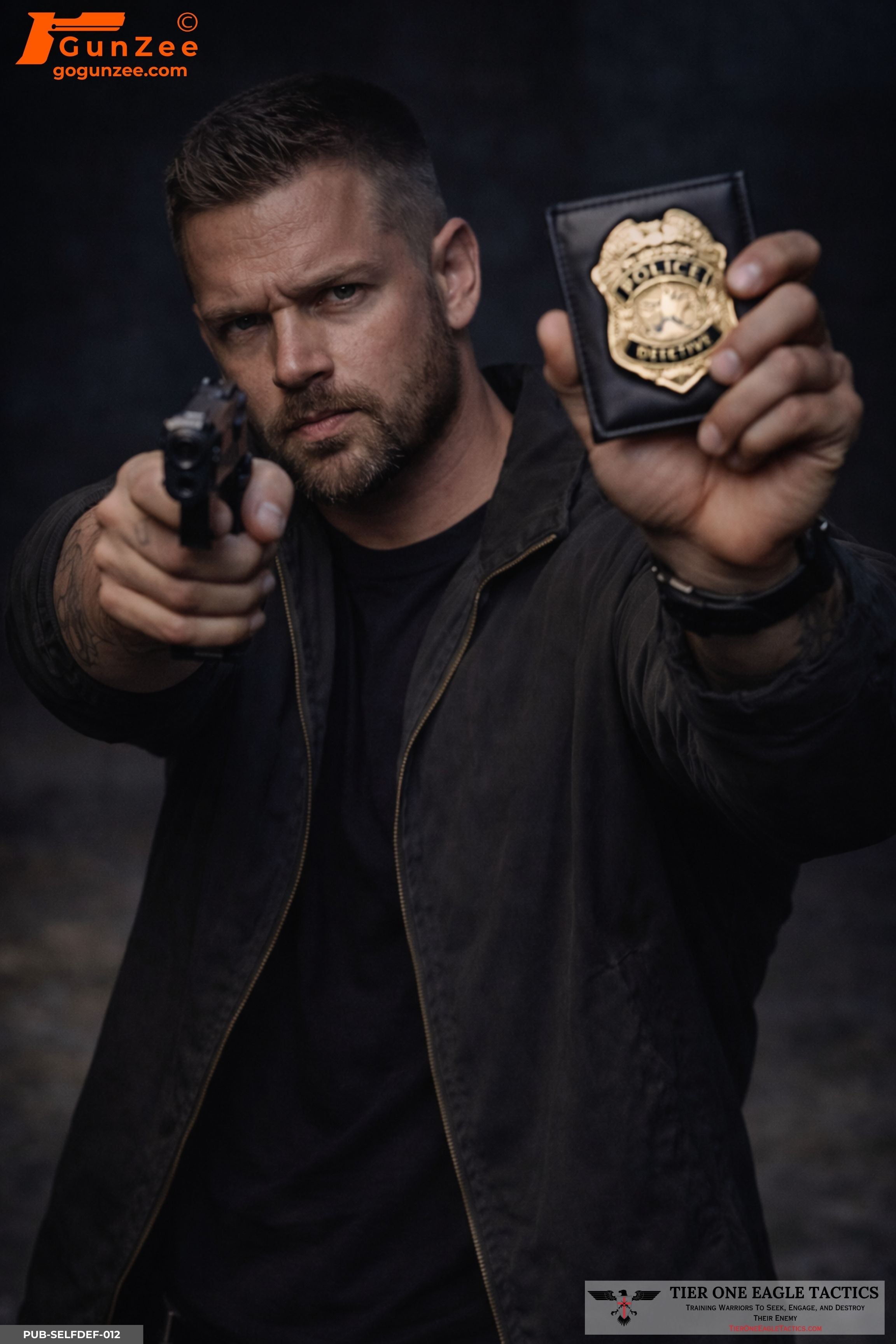
Low-Light Badge Presentation – Plainclothes Officer Identification Scenario [24" x 36"]
each · sold in 5s · mix any designs
Price drops automatically: 50+ $2.14 · 100+ $2.03 · 250+ $1.91 · Up to 25% off at 999+ · Volume quote →
$60 order minimum for your whole cart, not each design. Mix any targets.
Quantity must be in increments of 5
Low-Light Badge Presentation – Plainclothes Officer Identification Scenario
The Low-Light Badge Presentation shooting target presents a critical identification challenge involving a plainclothes law enforcement officer displaying a badge while simultaneously holding a firearm. Set in a reduced-visibility environment, this scenario forces the shooter to process conflicting visual cues—weapon presence versus lawful authority—before making any engagement decision.
This target addresses one of the most common and dangerous real-world judgment failures: reacting to a visible gun without first confirming context, identity, and intent.
Training Purpose
Low-light conditions significantly degrade perception, compress reaction time, and increase the likelihood of assumption-based decisions. When a plainclothes officer presents a badge while armed, shooters must deliberately slow their cognitive process just enough to confirm lawful authority, muzzle orientation, and behavioral intent.
This target is designed to reinforce disciplined visual confirmation and restraint under stress. It trains shooters to recognize that the presence of a firearm alone does not constitute a hostile threat, especially when authority indicators are present but subtle.
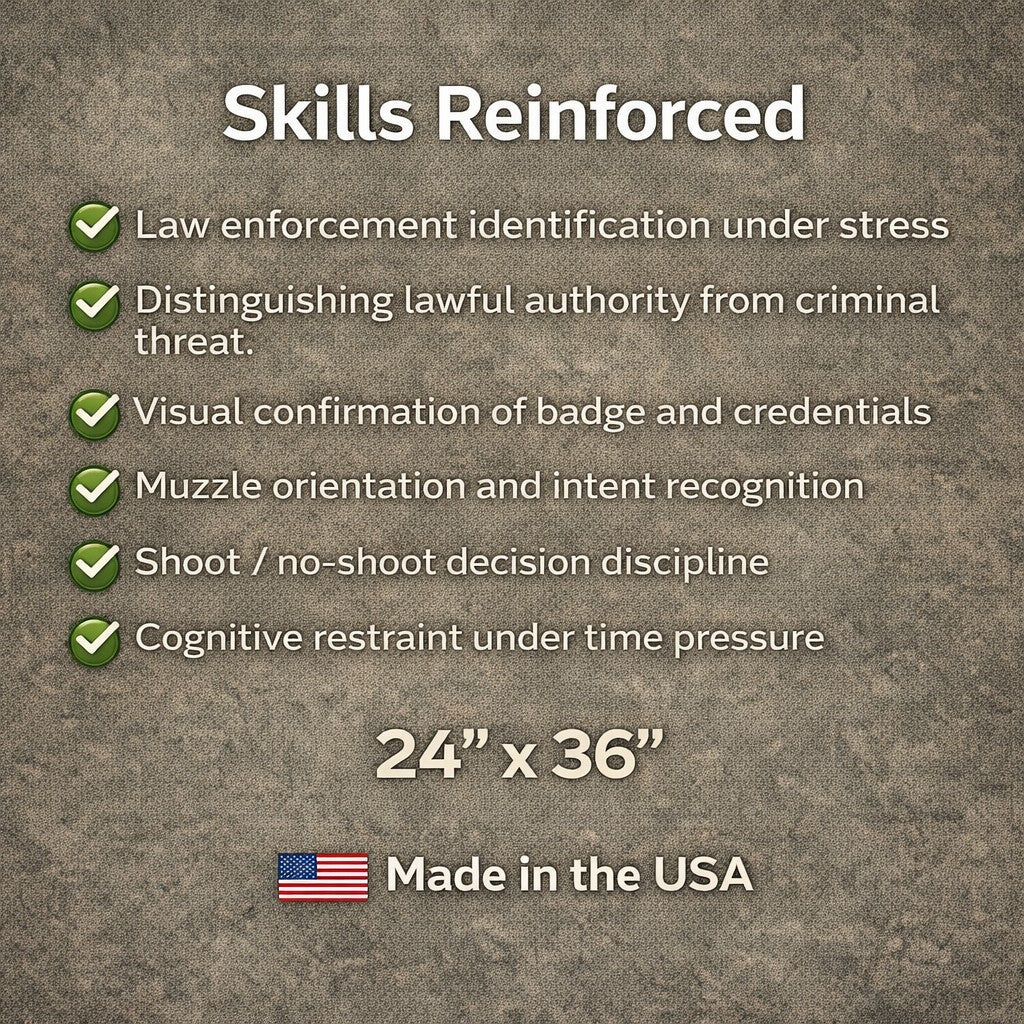
Skills Reinforced
- Law enforcement identification under low-light conditions
- Distinguishing lawful authority from criminal threat
- Visual confirmation of badge and credentials
- Muzzle orientation and intent recognition
- Shoot / no-shoot decision discipline
- Cognitive restraint under time pressure
Why This Target Is Different
Most shooting targets condition immediate engagement once a firearm is visible. This target intentionally breaks that conditioning by introducing legitimate authority cues that must be identified before any action is taken.
The shooter is required to:
- Actively search for and confirm a badge
- Balance weapon awareness with contextual indicators
- Suppress reflexive responses under stress
- Apply legal and ethical judgment before engagement
This target rewards restraint, accountability, and disciplined threat assessment rather than speed alone.
Scenario Context (Educational)
Plainclothes officers frequently operate during evening hours, low-light transitions, and poorly illuminated environments. In these conditions, badges may be partially obscured, weapon orientation may be misread, and stress can override proper identification protocols.
Identification Failure Risk
This scenario highlights how quickly misidentification can occur when lighting, stress, and weapon visibility combine—making confirmation of authority a non-negotiable step before action.
Related training targets
Pair this target with related scenarios from across the GunZee catalog:
Public and everyday self-defense: Low-Light Plainclothes Officer Contact – Authority Identification Scenario, Plainclothes Officer Badge Reveal – Law Enforcement Identification Scenario, Low-Light Plainclothes Officer Threat Assessment Scenario, Plainclothes Officer Contact & Crossfire Control – Partner Coordination Scenario
Home defense, CQB, and hostage: Interior Male Wearing Body Armor With Concealed Handgun Shooting Target, Dining Room Table Barricade Male With Inhaler Ambiguous Threat Shooting Target, CQB Home Defense Hostage – Two-Man Armed Threat Coordination Shooting Target
Vehicle and barrier: Vehicle Barrier Windshield Assault Shooting Target, Vehicle Approach Threat Advancing Gunman Shooting Target, Vehicle Barrier Windshield Gunman Engagement Shooting Target
Anatomical: Anatomical Semi-Frontal Handgun Threat Precision Shooting Target, Anatomical Semi-Profile Handgun Threat Vital Zone Shooting Target, Anatomical Hostage Shield Vital Zone Shooting Target