Read the Privacy Policy
Quantity must be in increments of 5
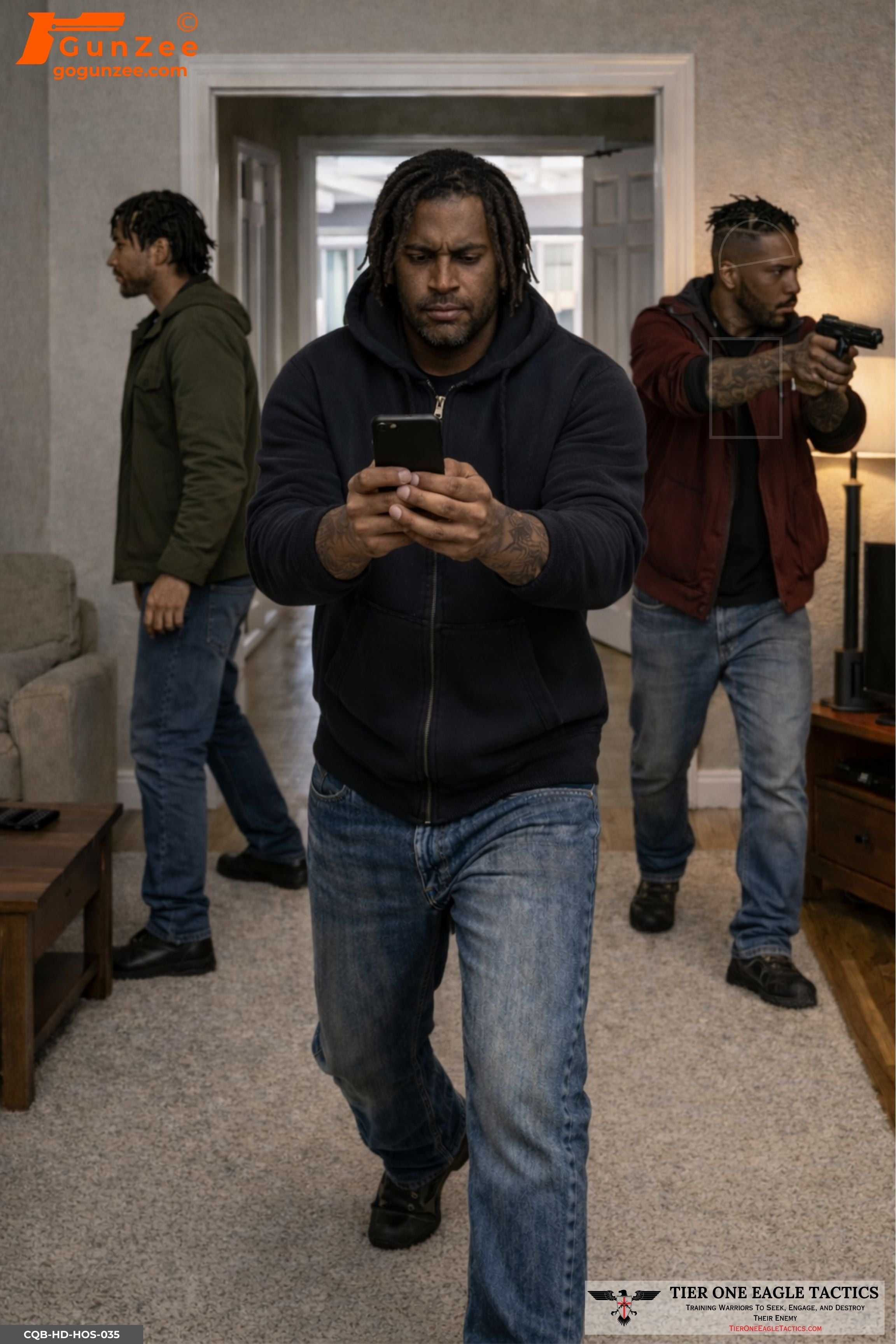
This target presents a complex interior home-invasion scenario involving three intruders operating simultaneously inside a residential living space. The central individual advances forward while focused on a cell phone, projecting distraction, non-engagement, or command-and-control behavior. To the left, a second individual moves away from the shooter, further pulling visual attention off the primary threat axis.
On the right, a third male maintains weapon orientation with a handgun, representing the confirmed lethal threat. His position, posture, and intent require rapid recognition despite competing movement, visual noise, and deception created by the other two subjects.
This scenario reflects coordinated intrusion tactics where non-armed or ambiguously tasked individuals are used to dilute attention while a designated gunman maintains lethal overwatch.
This target is designed to train shooters to maintain threat discipline in the presence of multiple moving subjects, varied intent cues, and deliberate misdirection. The exercise reinforces prioritization of actual lethality over proximity, posture, or perceived leadership.
Shooters must process movement, intent, and weapon presence simultaneously, identifying the armed individual without defaulting to the most visually dominant or centrally positioned subject.
Kill zones are applied exclusively to the male armed with the handgun, reinforcing correct threat identification and engagement accountability.... ...
This target presents a complex interior home-invasion scenario involving three intruders operating simultaneously inside a residential living space. The central individual advances forward while focused on a cell phone, projecting distraction, non-engagement, or command-and-control behavior. To the left, a second individual moves away from the shooter, further pulling visual attention off the primary threat axis.
On the right, a third male maintains weapon orientation with a handgun, representing the confirmed lethal threat. His position, posture, and intent require rapid recognition despite competing movement, visual noise, and deception created by the other two subjects.
This scenario reflects coordinated intrusion tactics where non-armed or ambiguously tasked individuals are used to dilute attention while a designated gunman maintains lethal overwatch.
This target is designed to train shooters to maintain threat discipline in the presence of multiple moving subjects, varied intent cues, and deliberate misdirection. The exercise reinforces prioritization of actual lethality over proximity, posture, or perceived leadership.
Shooters must process movement, intent, and weapon presence simultaneously, identifying the armed individual without defaulting to the most visually dominant or centrally positioned subject.
Kill zones are applied exclusively to the male armed with the handgun, reinforcing correct threat identification and engagement accountability. These zones support structured after-action review focused on shot placement, decision accuracy, and threat prioritization under stress.
The remaining individuals intentionally contain no kill zones, preventing conditioning toward proximity-based engagement and reinforcing disciplined threat confirmation.
Kill zones are integrated for analytical evaluation following the exercise and are not intended as visual aiming references during execution.
Pair this target with related scenarios from across the GunZee catalog:
Public and everyday self-defense: Low-Light Badge Presentation – Plainclothes Officer Identification Scenario, Backyard Pool Knife Assault – Crowd Chaos Scenario, Grocery Aisle Explosive Vest Imminent Threat Shooting Target
Home defense, CQB, and hostage: CQB Home Defense Hostage – Two-Man Armed Threat Coordination Shooting Target, Two-Man Residential Entry Armed Threat Shooting Target, Two-Man Interior Advance Dual Threat Shooting Target, Interior Two-Man Deception & Rear Threat Shooting Target
Vehicle and barrier: Vehicle Barrier Armed Driver Engagement Shooting Target, Vehicle Barrier Dual Gunmen Front-and-Rear Seat Engagement Shooting Target, Vehicle Barrier Multi-Aggressor Carjacking Shooting Target
Anatomical: Anatomical Head-Out Vehicle Window Engagement Shooting Target, Anatomical Hostage Shield Vital Zone Shooting Target, Anatomical Frontal Handgun Threat Vital Zone Shooting Target