
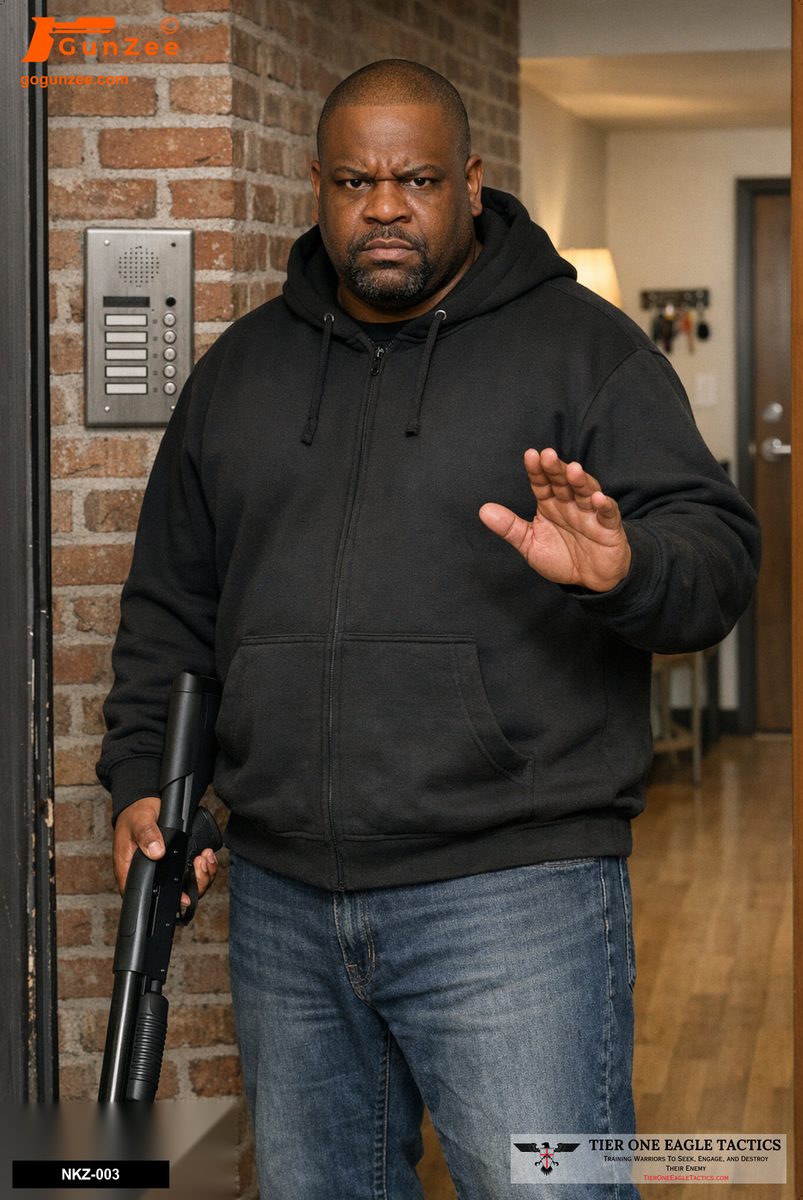
Apartment Foyer Aggressor Scenario Shooting Target [24" x 36"]
each · sold in 5s · mix any designs
Price drops automatically: 50+ $1.85 · 100+ $1.76 · 250+ $1.66 · Up to 25% off at 999+ · Volume quote →
$40 order minimum for your whole cart, not each design. Mix any targets.
Quantity must be in increments of 5
Apartment Foyer Aggressor Scenario Shooting Target
Life-size 24" x 36" scenario target depicting an armed threat in the Apartment Foyer Aggressor Scenario scenario. Trains scenario recognition, threat assessment, and precision engagement under realistic conditions — no printed T-boxes or scoring zones on the threat figure. Built for LE patrol officers, defensive-shooting civilians, and firearms instructors running qualification refreshers and scenario immersion drills.
This scenario mirrors high-stakes encounters often faced by law enforcement officers and home defense practitioners. The presence of an armed individual at the threshold of a home necessitates rapid threat assessment and decision-making. This target is particularly relevant for patrol officers, SWAT teams, and civilians with defensive shooting training, as it challenges the shooter to evaluate the threat level in a compressed timeframe. The environment's close quarters and the subject's stance require precise judgment under pressure. The urban apartment setting adds an additional layer of complexity, demanding attention to detail and quick adaptation to potential threats.
Training Purpose
NKZ targets are crafted to push shooters to apply their knowledge of human anatomy and shot placement in true-to-life scenarios without the aid of visual guides. This target challenges the shooter to interpret the threat's anatomy through posture, orientation, and clothing, rather than relying on printed cardiac boxes, T-boxes, or scoring zones. The absence of these visual aids requires shooters to engage with the scenario on a deeper level, using their training to identify the most effective shot placement.
Instructors can employ this target for a variety of training exercises, including cold cognitive drills where shooters encounter the scenario for the first time during the exercise. Timed engagements and integration with other NKZ targets can simulate real-world urgency and complexity, enhancing the training experience. This approach fosters the development of critical decision-making and precision engagement skills in a dynamic environment.
Skills Reinforced
- Applying anatomical... ...
Apartment Foyer Aggressor Scenario Shooting Target
Life-size 24" x 36" scenario target depicting an armed threat in the Apartment Foyer Aggressor Scenario scenario. Trains scenario recognition, threat assessment, and precision engagement under realistic conditions — no printed T-boxes or scoring zones on the threat figure. Built for LE patrol officers, defensive-shooting civilians, and firearms instructors running qualification refreshers and scenario immersion drills.
This scenario mirrors high-stakes encounters often faced by law enforcement officers and home defense practitioners. The presence of an armed individual at the threshold of a home necessitates rapid threat assessment and decision-making. This target is particularly relevant for patrol officers, SWAT teams, and civilians with defensive shooting training, as it challenges the shooter to evaluate the threat level in a compressed timeframe. The environment's close quarters and the subject's stance require precise judgment under pressure. The urban apartment setting adds an additional layer of complexity, demanding attention to detail and quick adaptation to potential threats.
Training Purpose
NKZ targets are crafted to push shooters to apply their knowledge of human anatomy and shot placement in true-to-life scenarios without the aid of visual guides. This target challenges the shooter to interpret the threat's anatomy through posture, orientation, and clothing, rather than relying on printed cardiac boxes, T-boxes, or scoring zones. The absence of these visual aids requires shooters to engage with the scenario on a deeper level, using their training to identify the most effective shot placement.
Instructors can employ this target for a variety of training exercises, including cold cognitive drills where shooters encounter the scenario for the first time during the exercise. Timed engagements and integration with other NKZ targets can simulate real-world urgency and complexity, enhancing the training experience. This approach fosters the development of critical decision-making and precision engagement skills in a dynamic environment.
Skills Reinforced
- Applying anatomical shot placement without visual overlays
- Reading vital-zone location from body position and orientation
- Precision engagement without diagrammatic guides
- Dynamic threat assessment under realistic conditions
- Situational awareness in complex environments
- Engagement timing and decision-making under pressure
- Movement and cover utilization in confined spaces
- Stress management and composure during high-stakes scenarios
- Environmental adaptation to urban settings
NKZ Series — No Printed Kill Boxes, No Scoring Zones
NKZ targets are specifically designed without any printed kill boxes, T-boxes, cardiac boxes, or scoring zones on the threat figures. This series caters to shooters who have mastered shot-placement anatomy and are ready to apply their knowledge without visual aids. It is intended for intermediate-to-advanced training, where the shooter must rely on their understanding of anatomy to neutralize threats effectively.
The realism of the scenario replaces traditional overlays, with body posture, orientation, and clothing serving as the anatomical reference points. Shooters must identify vital-zone locations based on what they observe in the scene, not from printed guides. This method enhances the training experience by demanding a higher level of cognitive engagement and precision.
Instructor Notes
For optimal training, instructors should position shooters at a realistic distance that reflects an apartment foyer encounter, typically between 5 to 10 yards. Starting from a holster or low-ready position is recommended to simulate real-world readiness. Scoring is based on shooter self-report or instructor observation, focusing on shot placement accuracy and decision-making speed. There is no printed grid to reference, which encourages shooters to rely on their training and judgment.
Who This Target Is For
This target is ideal for shooters who have completed foundational anatomy and shot placement training on diagrammatic targets and are ready to advance their skills. It is suitable for law enforcement qualification refreshers, instructor-led scenario immersion, advanced concealed carry training, and military pre-deployment exercises. The target's realistic environment and challenging decision-making requirements make it a valuable tool for enhancing critical skills in high-pressure situations.
Product Details
- Size: 24" x 36" paper — full-size, torso-plus-frame for realistic engagement distance
- Price: $1.95 each · volume tier discounts apply (50-99 = 5% off, 100-249 = 10% off, up to 25% at 999+)
- Print: True-to-life scenario imagery, life-like realism on heavy paper stock
- No printed kill boxes, T-boxes, or scoring zones on the threat figure
- Ships: Same day from Raleigh, NC — orders in by 2pm ET ship the same afternoon
- SKU: NKZ-003
Related NKZ Targets
Pair this target with other NKZ scenarios to build a mixed decision-making deck. Instructors: stringing 3-5 NKZ targets across a training block trains the shooter to process each new scene cold, without knowing whether the next reveal is an armed threat, a no-shoot, or a hostage engagement.
- Kitchen Defensive Stance
- Bedroom Man with Shotgun Low Ready
- Alleyway Woman Charging With Stick
- Car Interior Armed Suspect
- Afghan Interior Engagement Scenario
Browse the full NKZ — No Kill Zone Scenario Targets collection for all 59 targets in this series. See also the parent Paper Shooting Targets keystone, and the related Hostage Rescue Targets + Shoot / No-Shoot Targets keystones.