
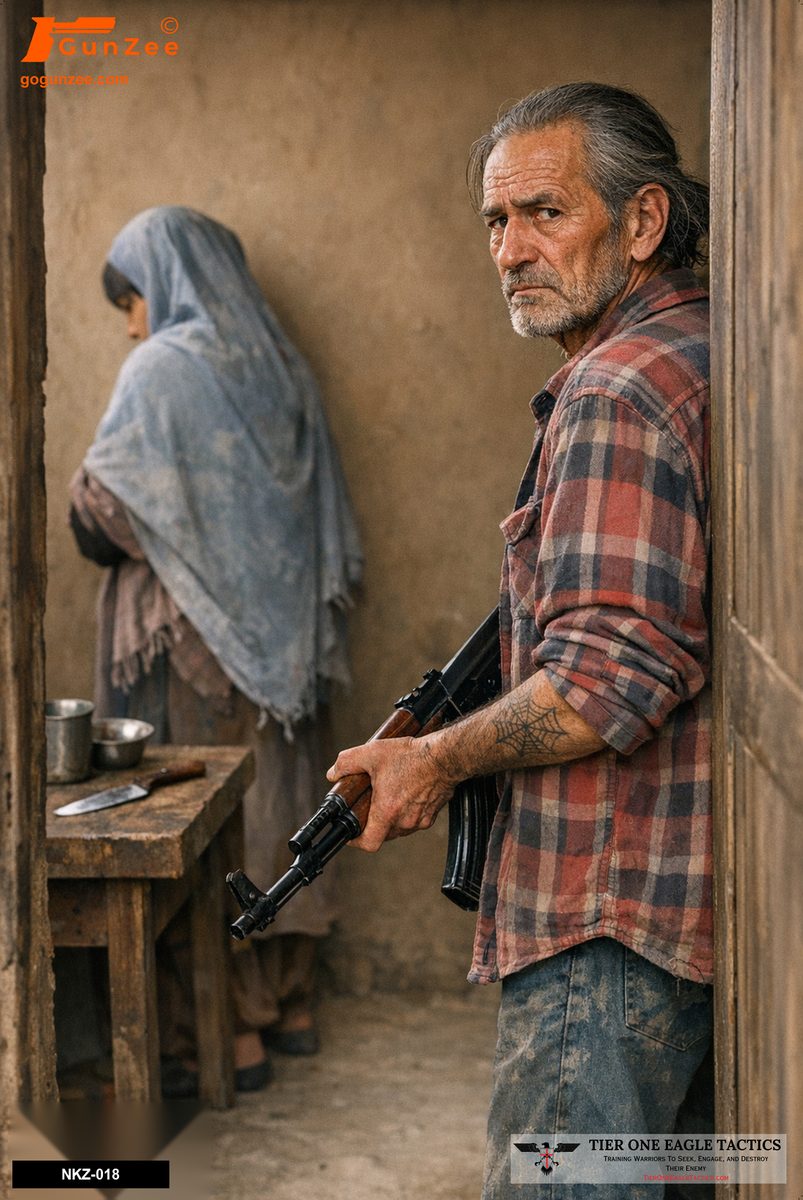
Kitchen Doorway Man With Rifle Shooting Target [24" x 36"]
each · sold in 5s · mix any designs
Price drops automatically: 50+ $1.85 · 100+ $1.76 · 250+ $1.66 · Up to 25% off at 999+ · Volume quote →
$40 order minimum for your whole cart, not each design. Mix any targets.
Quantity must be in increments of 5
Kitchen Doorway Man With Rifle Shooting Target
Life-size 24" x 36" scenario target depicting an armed threat in the Kitchen Doorway Man With Rifle scenario. Trains scenario recognition, threat assessment, and precision engagement under realistic conditions — no printed T-boxes or scoring zones on the threat figure. Built for LE patrol officers, defensive-shooting civilians, and firearms instructors running qualification refreshers and scenario immersion drills.
This scenario mirrors potential real-world encounters faced by military personnel and law enforcement officers in conflict zones or high-risk areas. The presence of the woman introduces a need for careful assessment, as she does not pose an immediate threat. This setup challenges shooters to evaluate the situation rapidly and decide on the appropriate course of action, essential for patrol officers and tactical teams in dynamic environments. The doorway setting adds a layer of spatial constraint, requiring precise engagement strategies. The confined space and presence of potential non-combatants demand a high level of situational awareness and tactical precision, making it a uniquely challenging scenario.
Training Purpose
The purpose of this target is to train shooters in applying their prior anatomical and shot-placement knowledge to a realistic scenario without printed guides. The shooter must discern the threat's anatomy through posture, orientation, and clothing, as there is no cardiac box, T-box, or scoring zone on the figure. This requires the shooter to rely on their understanding of human anatomy and their ability to read the scene for effective threat neutralization.
Instructors can utilize this target for cold cognitive drills and timed engagements. It can be strung with other NKZ targets to simulate a series of scenarios, enhancing the shooter's ability to process each scene independently. This approach reinforces mental agility and the ability to engage dynamically under stress.
Skills Reinforced
- Applying anatomical shot placement without visual overlays
- Reading vital-zone location from body position ... ...
Kitchen Doorway Man With Rifle Shooting Target
Life-size 24" x 36" scenario target depicting an armed threat in the Kitchen Doorway Man With Rifle scenario. Trains scenario recognition, threat assessment, and precision engagement under realistic conditions — no printed T-boxes or scoring zones on the threat figure. Built for LE patrol officers, defensive-shooting civilians, and firearms instructors running qualification refreshers and scenario immersion drills.
This scenario mirrors potential real-world encounters faced by military personnel and law enforcement officers in conflict zones or high-risk areas. The presence of the woman introduces a need for careful assessment, as she does not pose an immediate threat. This setup challenges shooters to evaluate the situation rapidly and decide on the appropriate course of action, essential for patrol officers and tactical teams in dynamic environments. The doorway setting adds a layer of spatial constraint, requiring precise engagement strategies. The confined space and presence of potential non-combatants demand a high level of situational awareness and tactical precision, making it a uniquely challenging scenario.
Training Purpose
The purpose of this target is to train shooters in applying their prior anatomical and shot-placement knowledge to a realistic scenario without printed guides. The shooter must discern the threat's anatomy through posture, orientation, and clothing, as there is no cardiac box, T-box, or scoring zone on the figure. This requires the shooter to rely on their understanding of human anatomy and their ability to read the scene for effective threat neutralization.
Instructors can utilize this target for cold cognitive drills and timed engagements. It can be strung with other NKZ targets to simulate a series of scenarios, enhancing the shooter's ability to process each scene independently. This approach reinforces mental agility and the ability to engage dynamically under stress.
Skills Reinforced
- Applying anatomical shot placement without visual overlays
- Reading vital-zone location from body position
- Precision engagement without diagrammatic guides
- Dynamic threat assessment under realistic conditions
- Spatial awareness in confined environments
- Decision making under pressure
- Rapid engagement strategy development
- Maintaining accuracy while moving
- Processing multiple visual cues efficiently
NKZ Series — No Printed Kill Boxes, No Scoring Zones
NKZ targets are made without any printed kill boxes, T-boxes, cardiac boxes, or scoring zones on the threat. The series is designed for shooters who already know shot-placement anatomy and are ready to apply that knowledge without visual aids. This is intermediate-to-advanced training, focusing on the shooter's ability to identify and engage threats based solely on their understanding of human anatomy and the visual cues present in the scene.
The realism of the target replaces traditional overlays. Body posture, orientation, and clothing become the anatomical reference points. The shooter must identify vital-zone location from what they see, not from what's printed, enhancing their ability to respond effectively in real-world scenarios.
Instructor Notes
For practical training, instructors should position shooters at varying distances to simulate different engagement ranges. Starting from a holster or carry-ready position emphasizes the importance of quick, accurate responses. Scoring is based on shot placement accuracy and the ability to correctly identify and engage the threat. There is no printed grid to reference; scoring relies on shooter self-report or instructor observation. This target can be used alongside other paper shooting targets for a comprehensive training deck, including scenarios with multiple threats.
Who This Target Is For
This target is ideal for law enforcement officers, military personnel, and defensive shooting instructors who have completed foundational anatomy and shot placement training on diagrammatic targets. It is suitable for LE qualification refreshers, instructor-led scenario immersion, advanced concealed carry training, and military pre-deployment exercises. This target helps shooters transition from basic to advanced skills by removing the printed guides of visual guides.
Product Details
- Size: 24" x 36" paper — full-size, torso-plus-frame for realistic engagement distance
- Price: $1.95 each · volume tier discounts apply (50-99 = 5% off, 100-249 = 10% off, up to 25% at 999+)
- Print: True-to-life scenario imagery, life-like realism on heavy paper stock
- No printed kill boxes, T-boxes, or scoring zones on the threat figure
- Ships: Same day from Raleigh, NC — orders in by 2pm ET ship the same afternoon
- SKU: NKZ-018
Related NKZ Targets
Pair this target with other NKZ scenarios to build a mixed decision-making deck. Instructors: stringing 3-5 NKZ targets across a training block trains the shooter to process each new scene cold, without knowing whether the next reveal is an armed threat, a no-shoot, or a hostage engagement.
- Hotel Room Aggressor with Rifle
- Room Interior Armed Suspect
- Afghan Interior Engagement Scenario
- Indoor Shelter Armed Suspect AK-47
- Interior Room Armed Suspect Rifle Aimed
Browse the full NKZ — No Kill Zone Scenario Targets collection for all 59 targets in this series. See also the parent Paper Shooting Targets keystone, and the related Hostage Rescue Targets + Shoot / No-Shoot Targets keystones.