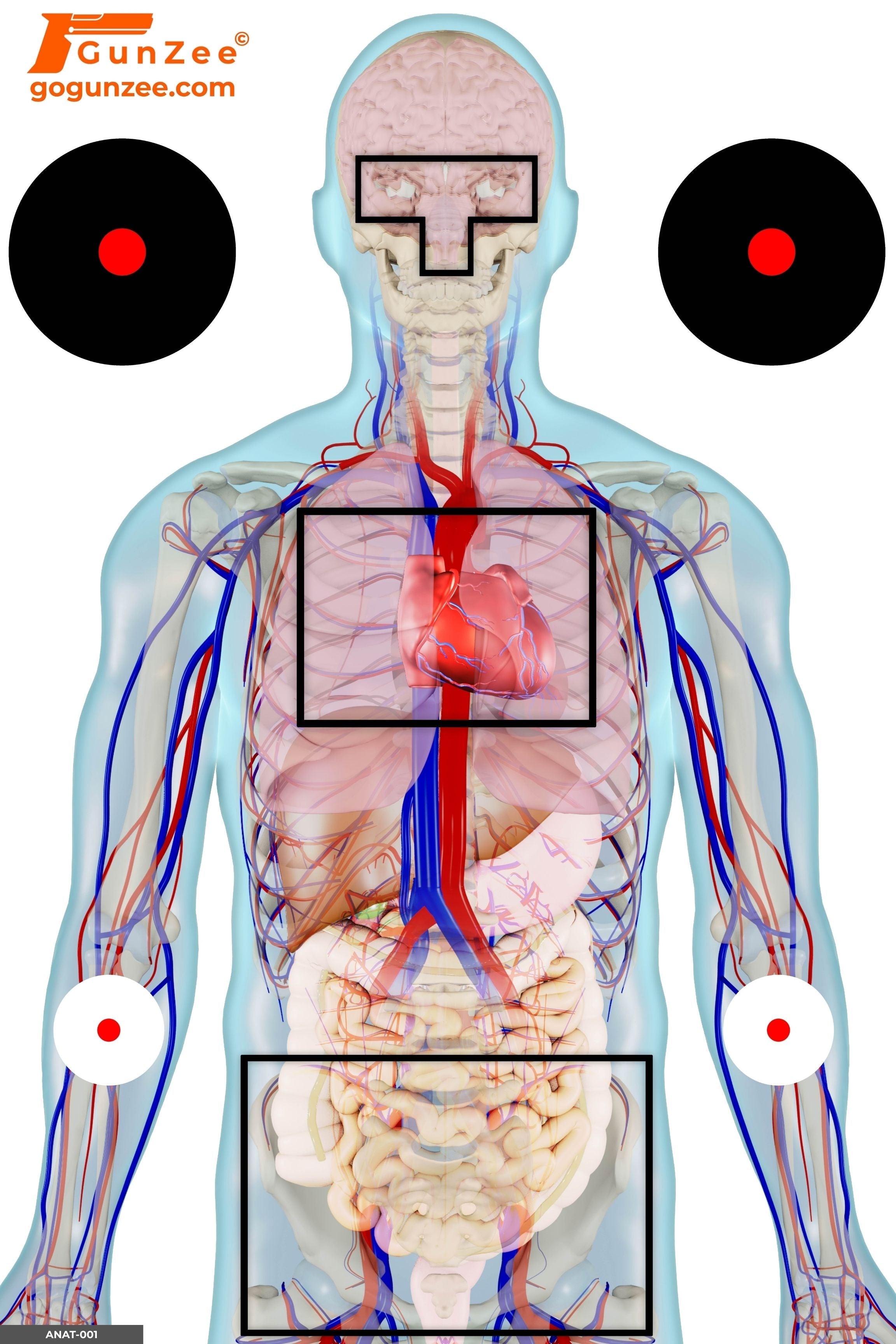
A B-27 silhouette teaches marksmanship. It does not teach defensive shooting. The difference matters more than most CCW holders realize — and it shows up at exactly the wrong moment, when a real engagement requires a decision before the trigger moves.
Defensive shooting scenarios are how serious shooters bridge that gap. Each scenario presents a specific decision — confirm a threat, choose a target, refuse a shot, prioritize between actors — and forces the shooter to read the situation before reacting. That decision-making muscle is built on paper, on the range, before it ever has to operate under live stress.
The list below is the ten defensive shooting scenarios that show up most often in concealed-carry case studies, ranked roughly by frequency. Each links to a photorealistic scenario shooting target purpose-built for the drill. Use them to map current training against the situations that actually matter.

The ten scenarios that matter most
1. Bedroom doorway, middle of the night
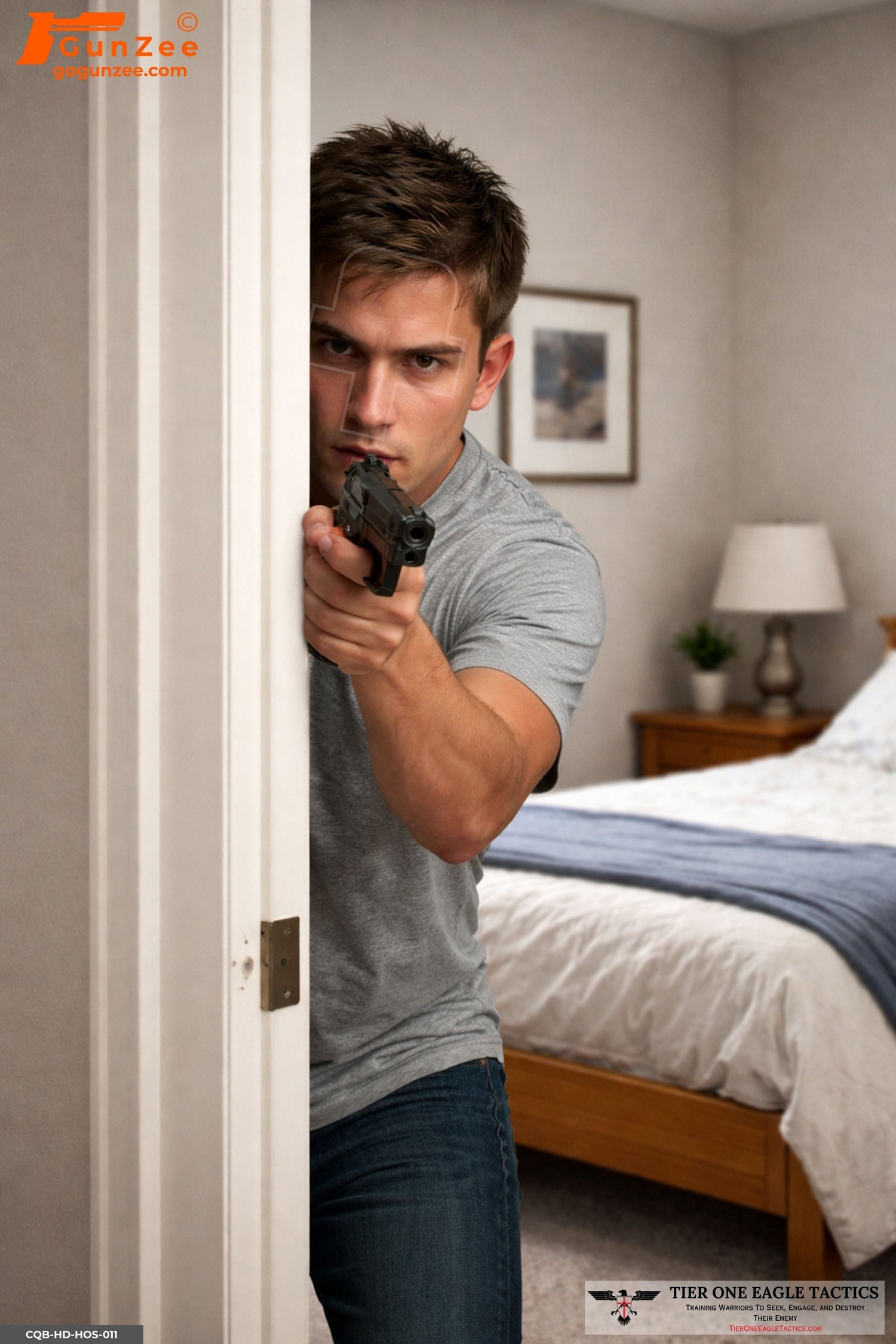
The most common home-defense scenario in the country. You wake up, you hear something, and the threat is at or just inside a doorway. The variables compound fast: is the figure armed, are they a household member, is the silhouette in low light actually what your brain is telling you it is?
Train this on a bedroom doorway armed subject target at five to seven yards. The drill is three counts of read-the-scene before the draw stroke. Most failures in real engagements aren't accuracy — they're misidentification.
2. Deceptive familiarity — kitchen confrontation
A spouse, teenager, or roommate appears in your hallway holding something. Identity is processing in parallel with threat assessment, and the two interfere with each other. A deceptive familiarity kitchen target trains the discipline of confirming hands and weapons before identity short-circuits judgment. The cost of getting this wrong is unrecoverable.

3. ATM ambush from the blind side
Public spaces with no escape route and an attacker who chose the ground. The ATM rear-aspect ambush target shows the muzzle-orientation problem — you may have to engage in a direction your body isn't facing — and the shot accountability problem (parking lot full of bystanders behind the threat). Train this as a movement-and-decision drill, not just a marksmanship one.
4. Café role reversal — the armed victim
The most counterintuitive scenario on this list and one most shooters never see coming. The "victim" produces a weapon and becomes the immediate threat. The café role reversal target flips the easy mental model and exposes pattern-matching errors. Anyone who has only trained hostages as people to protect will lock up the first time this scenario runs.
5. Bank lobby active robbery, multiple armed suspects
The scenario that argues for prioritization training. The bank lobby with multiple armed suspects in body armor target trains the sequencing problem: which threat is immediate, which is developing, and where does the round behind the first shot have to land. Body-armor exposure also reshapes the shot picture — center mass is no longer the answer.

6. Grocery store parking lot — armed approach
Open ground, civilians moving, a closing threat. The grocery store parking lot armed approach target trains shot accountability under public-space backdrops. There is no clean backstop, and the round fired has consequences for everyone in the direction it travels. Practice this until the shot decision automatically includes "what's behind the threat."
7. Vehicle barrier — carjacking confrontation
The vehicle-defense scenario most likely to happen at an intersection or driveway. A vehicle barrier carjacking target presents the geometry of an attacker pressed against the driver's-side window. Sight pictures are constrained by glass, mirror, and pillar. The draw stroke is constrained by seat belt and steering wheel. Train this without skipping the constraints.

8. Workplace active shooter response
The scenario where preparation has shifted from "if" to "when" in many professions. The workplace active shooter response target trains rapid engagement against a known-armed threat at varying distances. The decision is rarely "do I shoot" — it's "what's my next 30 seconds." Movement, cover, and communication all attach to this drill.
9. Church aisle hostage crisis
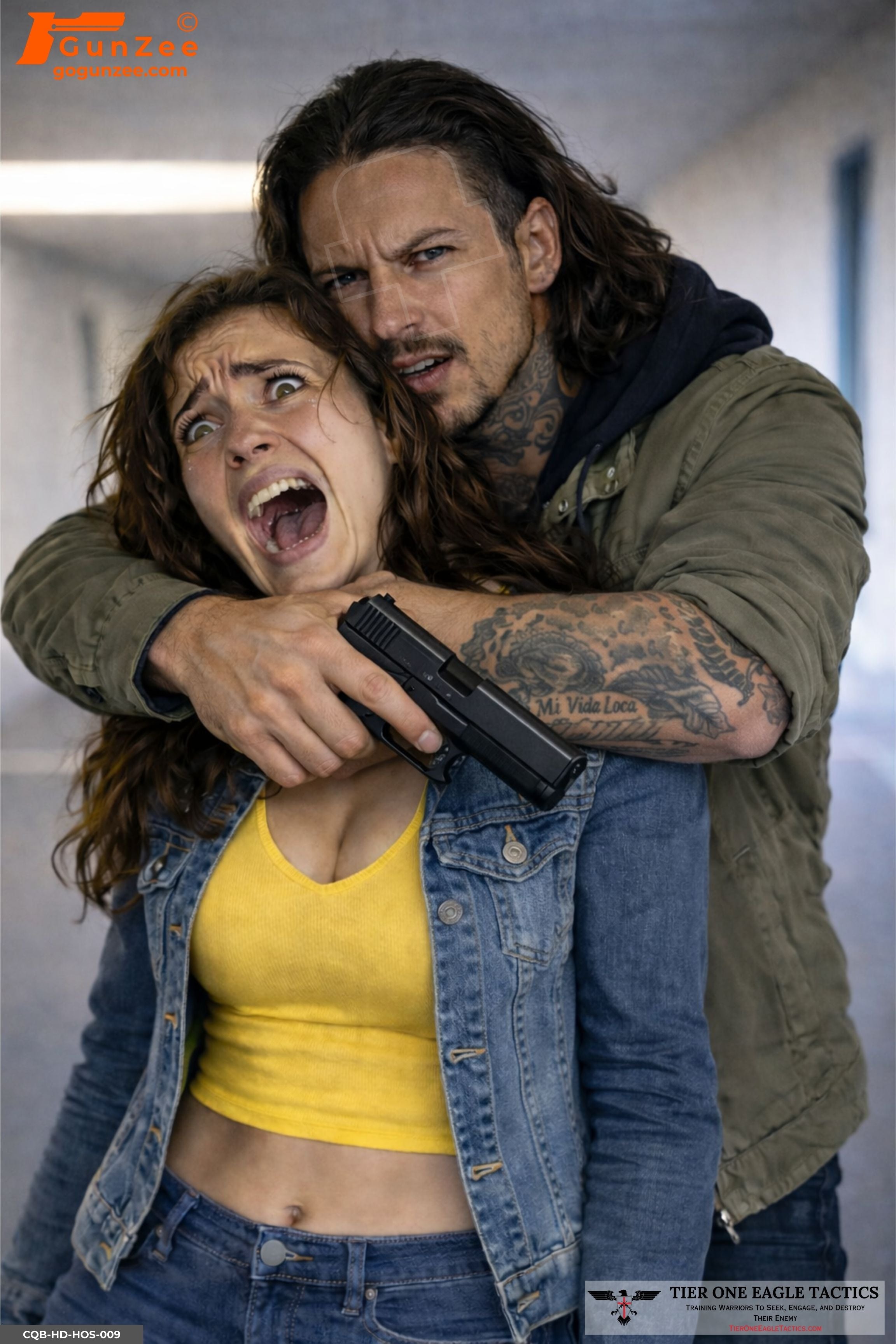
A specific subset of the hostage scenario family, but worth its own slot because the backdrop is full of non-combatants and the angle of engagement matters enormously. A church aisle hostage crisis target trains shot accountability in a venue where every direction has civilians. Most shooters never practice with this many people in the field behind the threat.
10. Crowded street — hostage with concealed gunman
The scenario that argues for restraint training. A crowded street hostage with concealed gunman target presents the worst-case version of the angle problem: small viable hit zone, multiple non-combatants in every direction, no clean backstop. The right answer is sometimes "don't shoot yet." Train the version of the trained shooter who can wait.

The common thread
Every scenario above has the same underlying structure: assess, decide, execute. The shot is the easy part. The decision is the muscle no static target builds. Two failure modes show up in real engagements again and again — shooting too soon when the threat wasn't actually confirmed, and freezing when the decision is harder than the rep would predict. Both are trained on photorealistic scenario targets and untrained anywhere else.
The other common thread: every one of these scenarios contains a non-combatant. A hostage, a bystander, a family member, a coworker. Defensive shooting is rarely a one-actor problem. Build that into the training tempo from day one.
Where to start
For a CCW holder new to scenario training, pick three from the list above that match the venues actually encountered day to day. Urban commuter with a public-facing job: scenarios 3 (ATM), 5 (bank lobby), 6 (grocery parking lot), 8 (workplace) are the most relevant. Multi-bedroom home, less travel: prioritize 1 (bedroom doorway), 2 (deceptive familiarity), 10 (hostage angle).
Run each chosen scenario through the four-step structure: read-the-scene, verbalize the threat, commit to the action, debrief the rounds. Slow tempo. Three to five reps per session beats fifty reps without verbalization.
For a group, training school, or department, the CQB Full Structure Rotation 295-pack covers the bulk of the categories above with enough volume to run multi-shooter rotations.
The full hostage and CQB library lives in the Home Defense, CQB & Hostage Scenarios collection. The public-space scenarios live in Public & Everyday Self-Defense. Browse by decision category, not by aesthetics — the targets that look prettiest are not the targets that most need to be trained.
→ BROWSE THE FULL CQB & HOSTAGE SCENARIO LIBRARY
Frequently asked questions
What is a defensive shooting scenario?
A defensive shooting scenario is a training drill built around a specific real-world engagement type — bedroom doorway, parking lot ambush, vehicle confrontation, etc. — with a photorealistic target that depicts the threat in context. The training value is the decision-making rep, not just the marksmanship rep.
How is this different from regular marksmanship training?
Regular marksmanship training builds the mechanical skill to put rounds where intended. Scenario training builds the cognitive skill to decide where they go in the first place. Both matter; they are not interchangeable. Most CCW holders are over-trained on the first and under-trained on the second.
Do I need different targets for each scenario?
Yes for serious training. The visual cues that drive decision-making — what the threat is holding, where the hostage stands, what's behind the engagement zone — are scenario-specific. A generic silhouette doesn't trigger the same processing. A serious training cycle uses five to ten varied scenarios; a single target dozens of times defeats the purpose by creating pattern-matching.
How often should defensive scenarios be trained?
At least once per month, ideally weekly. Decision-making is a perishable skill — more perishable than marksmanship. A shooter who runs scenario drills weekly will outperform a shooter who runs them quarterly, even with identical marksmanship.
Are these scenarios appropriate for new CCW holders?
The marksmanship prerequisite is the ability to make accurate headshots at fifteen yards on a static target. Below that level, scenario training adds decision noise to an unstable foundation. Build the mechanical skill first; layer scenarios after.
What's the right distance for scenario training?
Most defensive engagements happen inside seven yards. Train at three, five, and seven primarily, with occasional fifteen-yard reps to maintain longer-range accuracy. The exception is the active-shooter scenario, where engagement may occur at fifteen to twenty-five yards — train those at the longer distance.
Can scenario targets prepare me for force-on-force training?
Yes. Paper-based scenario training is the right preparation phase before live force-on-force, because it lets the shooter build visual-processing reps without the cognitive overhead of a moving partner. Most professional schools build a paper-scenario week into the curriculum before students enter the simulator or face role-players.
Go deeper: every scenario above is a decision first and a shot second — build that layer with shoot / no-shoot judgment drills, see the full target-type rotation, and browse the paper shooting targets collection.