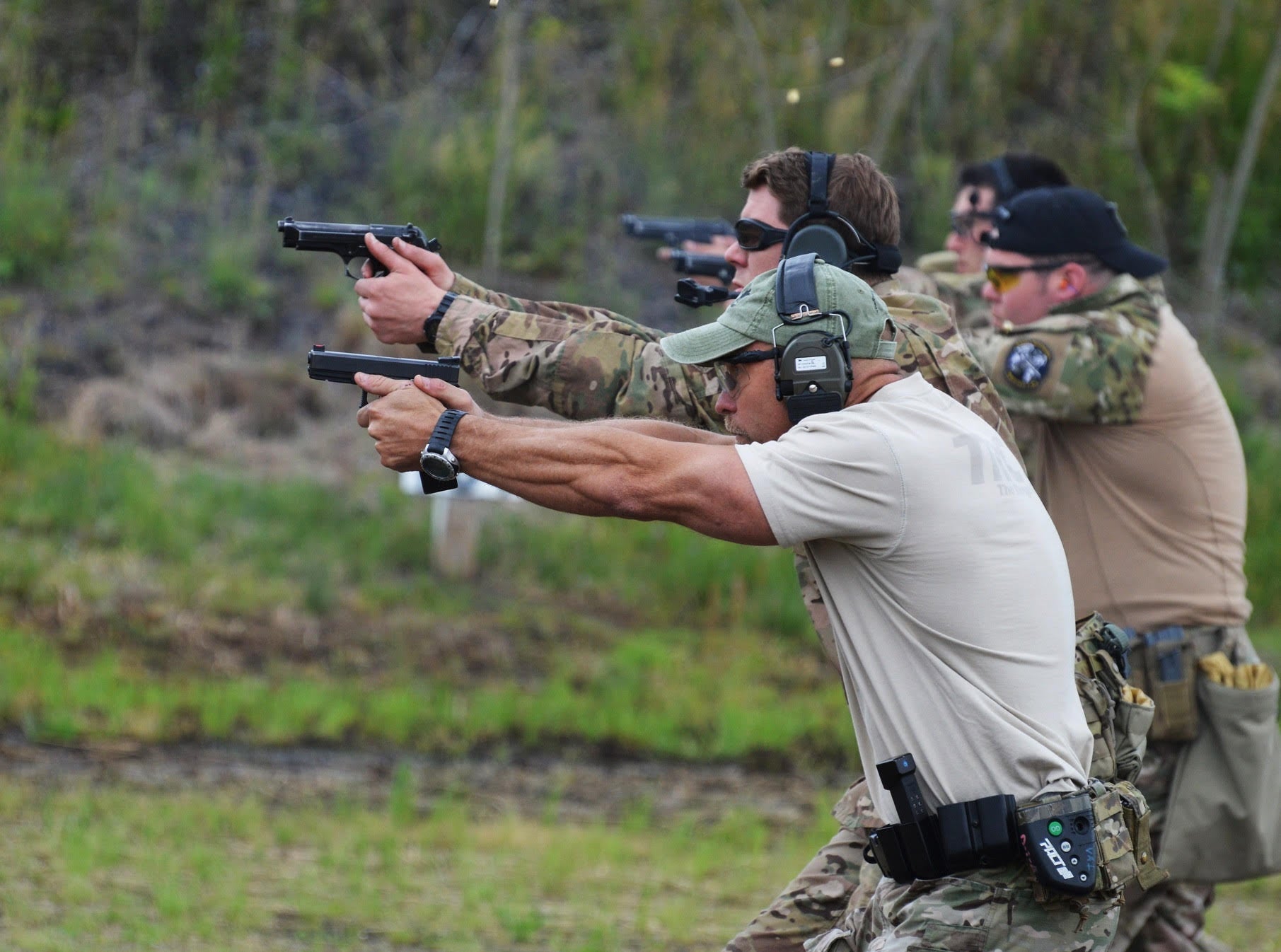
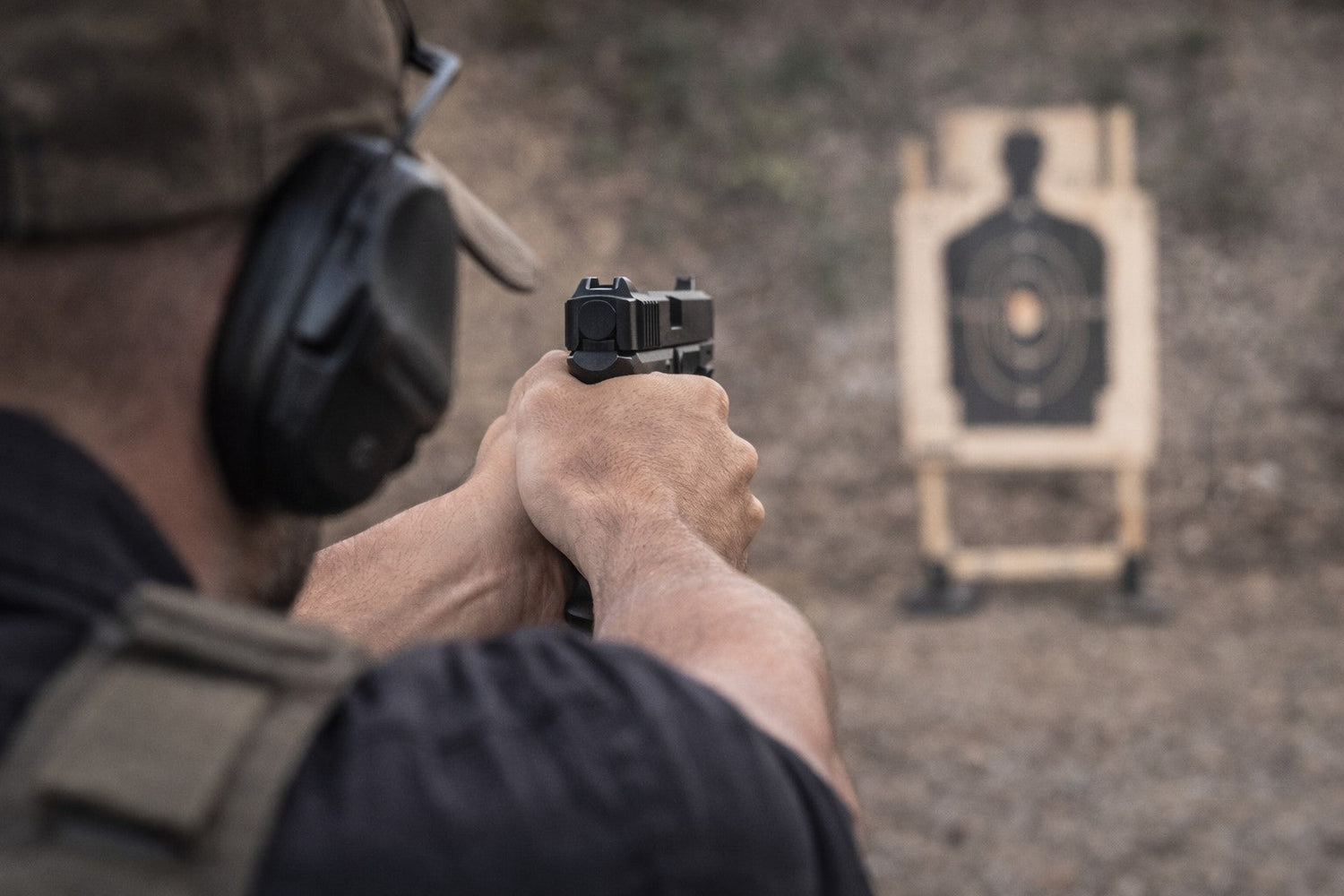
Accurate shooting is not about speed, strength, or expensive gear. It is built on disciplined fundamentals. Whether you are new to firearms training or refining advanced skills, mastery of grip, stance, sight alignment, and trigger control forms the foundation for consistent accuracy.
Every advanced technique in defensive shooting builds on these core mechanics. When fundamentals are strong, performance under pressure improves. When fundamentals are weak, inconsistency follows.
This guide breaks down the essential mechanics of accurate handgun shooting and explains how to train them deliberately.
Proper Handgun Grip
Grip is the single most influential factor in recoil control and shot consistency.
A proper grip does three things:
- Stabilizes the firearm
- Controls recoil
- Allows consistent trigger manipulation
The Dominant Hand
Your dominant hand should sit high on the backstrap of the handgun. The web of your hand should be as high as possible without interfering with slide movement. A higher grip reduces muzzle flip and shortens recovery time between shots.
Your middle finger should be firmly pressed under the trigger guard. The remaining fingers wrap naturally around the grip, applying firm rearward pressure.
Avoid excessive squeezing with the dominant hand alone. Over-gripping with the firing hand can cause tremors and disrupt trigger control.
The Support Hand
The support hand does most of the recoil management.
- Rotate the support hand forward so the palm fills the open space on the grip panel.
- Apply forward and inward pressure.
- Thumbs should generally point forward (modern thumbs-forward grip).
Grip pressure should be firm but not tense. Think controlled compression, not strain.
Stance Variations: Isosceles vs Weaver
Your stance provides structural support for recoil management and stability.
Two primary stances dominate modern handgun training.
Isosceles Stance
The isosceles stance is widely used in defensive and competitive shooting.
- Feet shoulder-width apart
- Knees slightly bent
- Shoulders squared to the target
- Arms extended evenly
This stance creates a symmetrical platform. It works well with body armor, modern defensive training, and rapid threat transitions.
Most modern defensive shooters default to this position.
Weaver Stance
The Weaver stance uses a bladed body position.
- Strong-side foot slightly rearward
- Strong arm extended
- Support arm bent
- Push-pull tension between hands
Historically popular, the Weaver stance can still be effective, but it requires more coordination and is less commonly taught in modern defensive programs.
Which Should You Use?
For most shooters training for defensive readiness, the isosceles stance is simpler, more adaptable, and easier to reproduce under stress.
The key is consistency. Pick a stance that allows:
- Forward body weight
- Aggressive posture
- Natural recoil absorption
Sight Picture vs Sight Alignment
Many shooters confuse these two concepts.
Understanding the difference improves precision dramatically.
Sight Alignment
Sight alignment refers to the relationship between the front and rear sights.
For iron sights:
- Front sight centered in rear notch
- Equal light on both sides
- Top of front sight level with rear sight
Sight alignment is the mechanical alignment of the firearm.
Sight Picture
Sight picture is sight alignment placed on the target.
You maintain proper alignment and superimpose it over the intended point of impact.
For most defensive shooting:
- Focus should remain on the front sight
- The target will appear slightly blurred
The front sight should be visually sharp.
Inconsistent focus between target and sight is a common cause of missed shots.
Trigger Press Mechanics
Trigger control separates disciplined shooters from inconsistent ones.
The goal is a smooth, uninterrupted rearward press that does not disturb sight alignment.
Finger Placement
Generally:
- The center of the pad of your index finger should contact the trigger
- Avoid too much finger (causes lateral push)
- Avoid too little finger (causes pulling)
Placement may vary slightly depending on hand size and trigger geometry.
The Press
The trigger should move straight to the rear.
Avoid:
- Jerking
- Slapping
- Anticipating recoil
The press should feel like steady compression, not a sudden motion.
A helpful mental cue:
“Surprise break.”
The shot should fire without a flinch or anticipatory dip of the muzzle.
Follow-Through
Follow-through is often overlooked but critical for consistency.
After the shot breaks:
- Maintain grip pressure
- Keep sights on target
- Allow the trigger to reset under control
Do not immediately relax or drop the firearm.
Follow-through ensures:
- Accurate shot confirmation
- Controlled reset
- Faster, more accurate follow-up shots
A disciplined shooter calls the shot — meaning they know where the sights were at the moment of discharge.
Building Accuracy Through Deliberate Practice
Fundamentals are not developed through random repetition. They require structured training.
A strong training plan should include:
- Slow, precision shooting at close distance
- Dry fire sessions focused on trigger isolation
- Recoil management drills
- Diagnostic targets to reveal grip and trigger errors
When fundamentals are solid, speed becomes natural. When fundamentals are weak, speed only amplifies mistakes.
Final Thoughts
Accurate shooting is built on repeatable mechanics:
- Stable grip
- Balanced stance
- Proper sight alignment
- Smooth trigger press
- Disciplined follow-through
Master these elements and everything else becomes refinement.
Skip them, and progress stalls.
The fundamentals are not glamorous — but they are what separate confident shooters from inconsistent ones.
Train with intention. Refine the basics. Build accuracy from the ground up.