If you want to improve your shooting faster — and spend less money on ammunition — dry fire training is not optional.
It is foundational.
Elite shooters across defensive, military, and competitive disciplines rely heavily on dry fire to refine mechanics. The reason is simple: dry fire isolates fundamentals without recoil, noise, or distraction.
Done correctly, dry fire builds:
- Trigger discipline
- Grip consistency
- Sight stability
- Presentation efficiency
- Confidence
This guide walks you through how to train safely and effectively without stepping onto the range.
Safe Dry Fire Setup
Safety is non-negotiable.
Before beginning any dry fire session:
- Remove all live ammunition from the room.
- Unload the firearm completely.
- Visually and physically inspect the chamber.
- Verify again.
Create a dedicated dry fire space with:
- A safe direction (solid wall, no occupied room beyond)
- Minimal distractions
- Consistent lighting
Never mix dry fire and live fire in the same session without a full reset.
Discipline in setup prevents complacency.
The Wall Drill
The wall drill is one of the most powerful dry fire exercises available.
It isolates trigger control.
How It Works
- Stand a few inches from a blank wall.
- Aim at a small, precise point.
- Align sights carefully.
- Press the trigger slowly to the rear.
- Observe the front sight.
Because you are close to the wall:
- There is no target distraction.
- Only sight movement is visible.
If the front sight dips, twitches, or shifts at the break, you are disturbing the gun during the press.
The goal:
Zero movement at the moment the trigger breaks.
The wall drill trains pure trigger discipline.
Presentation Practice
In defensive shooting, accuracy must be paired with efficiency.
Presentation practice develops:
- Consistent draw mechanics
- Sight acquisition speed
- Grip establishment under movement
Basic Presentation Drill
- Start from a safe ready position (or holstered if trained and safe).
- Drive the firearm toward eye level.
- Acquire a clean sight picture.
- Press the trigger smoothly.
- Reset deliberately.
The focus is not speed — it is consistency.
Each repetition should feel identical.
Dry fire is where you eliminate wasted motion.
Trigger Isolation
Trigger control often degrades when shooters try to increase speed.
Dry fire allows you to isolate and refine the press.
Focus Points
- Maintain grip stability.
- Press straight to the rear.
- Observe the sights through the entire motion.
- Hold the trigger to the rear after the break.
- Reset deliberately.
Many shooters rush the reset in live fire.
Dry fire reinforces control.
The smoother your dry press, the more stable your live fire shots.
Building a Structured Weekly Routine
Dry fire becomes powerful when it is structured — not random.
A simple 15-minute routine performed 3–5 times per week produces measurable improvement.
Sample Weekly Structure
Day 1: Trigger Discipline
- 5 minutes wall drill
- 5 minutes slow press reps
- 5 minutes reset practice
Day 2: Presentation & Sight Acquisition
- 5 minutes draw/presentation reps
- 5 minutes sight confirmation holds
- 5 minutes controlled cadence reps
Day 3: Integrated Mechanics
- 5 minutes presentation
- 5 minutes trigger isolation
- 5 minutes simulated follow-up shots
Repetition builds neural efficiency.
Consistency builds confidence.
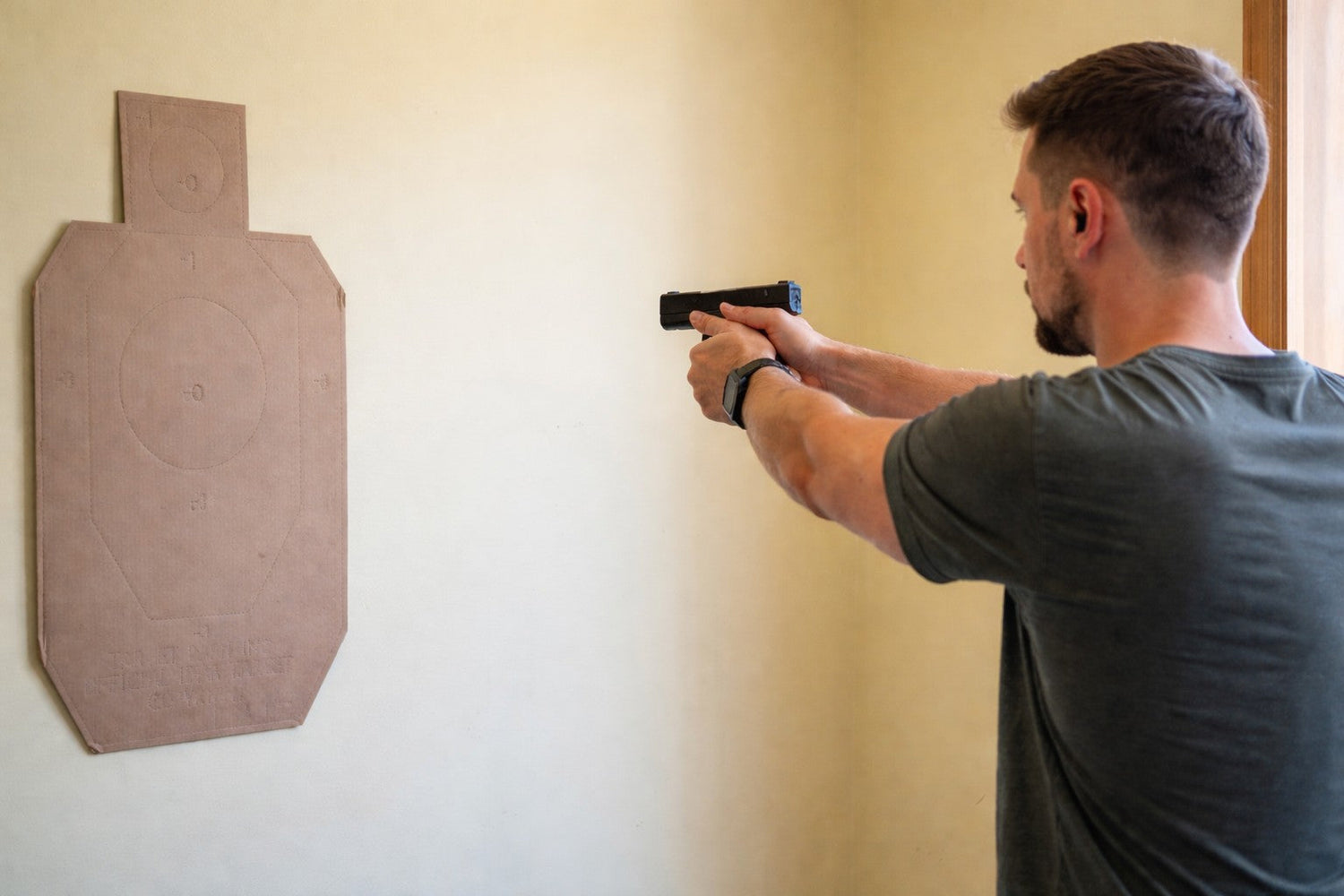
Using Printable Mini Targets
Adding small visual targets increases accountability.
Instead of aiming at a blank wall, use:
- Reduced-size bullseyes
- Small circles
- Anatomical mini targets
Smaller aiming points force greater visual discipline.
Dry fire becomes measurable when you demand precision.
You can rotate target types weekly to simulate:
- Upper thoracic shots
- Pelvic zone alignment
- Small precision hits
This bridges dry fire directly into live-fire performance.
Common Dry Fire Mistakes
Avoid these pitfalls:
- Rushing repetitions
- Practicing without focus
- Neglecting safety protocol
- Reinforcing sloppy presentation
- Training only for speed
Dry fire should be deliberate.
Every repetition is programming your mechanics.
Sloppy practice builds sloppy habits.
Why Dry Fire Accelerates Improvement
Live fire introduces:
- Recoil
- Noise
- Time pressure
- Ammunition cost
Dry fire removes those variables and isolates mechanics.
When live fire resumes:
- Trigger press feels cleaner
- Sight tracking improves
- Follow-up shots become more controlled
- Confidence increases
Dry fire is the foundation that supports realistic scenario training and recoil management.
Final Thoughts
You do not need to visit the range every day to improve.
You need structure.
Dry fire builds:
- Mechanical precision
- Trigger discipline
- Presentation efficiency
- Visual control
When done safely and consistently, it becomes one of the most valuable training tools available.
Train intentionally. Train consistently. Train safely.
Improvement is built in repetition — not in noise.